Have you ever wondered why the same challenges seem to show up in different relationships? Maybe you’ve had different partners, different friendships, different jobs, and different circumstances, yet somehow the feelings remain familiar.
You feel overlooked.
Misunderstood.
Taken for granted.
Not enough.
Or perhaps you find yourself constantly giving more than you receive, struggling to set boundaries, avoiding difficult conversations, or feeling disconnected from the people you care about most.
Many people assume these struggles are caused by the people around them. While others certainly play a role, there’s another relationship that often goes unnoticed.
The relationship you have with yourself.
The truth is that the way you think about yourself, treat yourself, and relate to yourself quietly influences every interaction you have with everyone else. If your relationship with yourself is strained, disconnected, or built on criticism rather than compassion, it often shows up in ways you may not even realize.
Here are seven signs your relationship with yourself may be affecting every other relationship in your life.
1. You Struggle to Set and Maintain Boundaries
Many people think boundaries are about controlling other people’s behavior. They aren’t.
Boundaries are about identifying what is acceptable for you and communicating that clearly.
When your relationship with yourself is healthy, you trust your feelings enough to honor them.
When your relationship with yourself is weak, you may second-guess your needs, ignore your discomfort, or convince yourself that what you want doesn’t matter.
As a result, you say yes when you mean no.
You overextend yourself.
You tolerate behavior that hurts you.
Then resentment begins to grow.
Healthy boundaries begin with self-respect.
2. You Need Constant Reassurance
Everyone needs reassurance from time to time. The problem arises when reassurance becomes the primary source of emotional stability.
If your sense of worth depends on what other people think of you, you’ll constantly search for evidence that you’re loved, accepted, valued, or enough.
You may repeatedly ask:
“Are we okay?”
“Do you still love me?”
“Did I do something wrong?”
No amount of reassurance from another person can permanently fill a gap that exists within your relationship with yourself. Eventually, the reassurance fades and the anxiety returns. True confidence comes from developing trust in yourself rather than constantly seeking proof from others.
3. You Prioritize Everyone Else’s Needs Over Your Own
Many people wear self-sacrifice like a badge of honor.
They’re the helper.
The caretaker.
The dependable one.
The strong one.
Yet underneath this pattern is often a painful belief:
“My needs aren’t as important as everyone else’s.”
Over time this creates exhaustion, resentment, and emotional disconnection.
Ironically, the people who love you most often don’t want you to abandon yourself for them. A healthy relationship with yourself allows you to care for others without disappearing in the process.
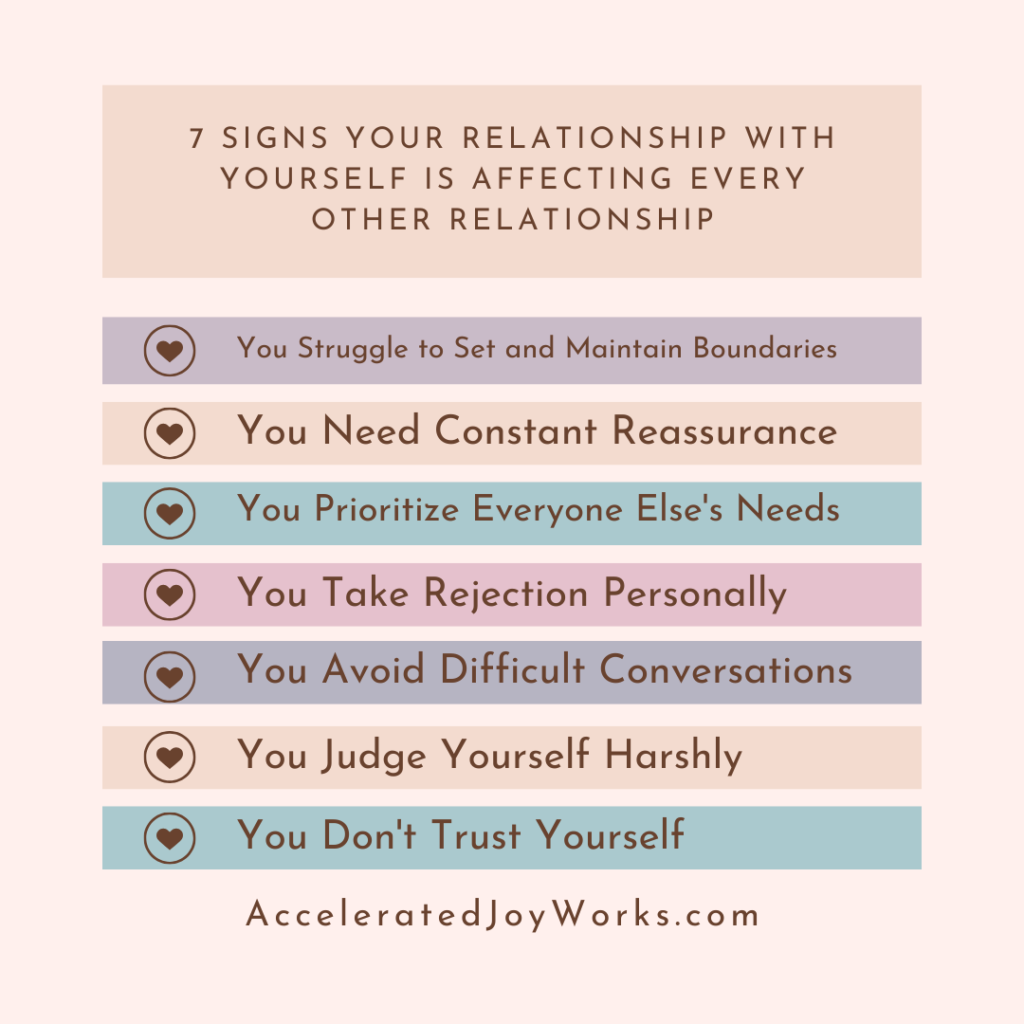
4. You Take Rejection Personally
Rejection hurts. That’s normal. But when rejection becomes evidence that you’re fundamentally unworthy, something deeper is happening.
A delayed text becomes proof you’re not important.
Constructive feedback feels like a personal attack.
A relationship ending becomes confirmation that you’re not lovable.
When your relationship with yourself is grounded and secure, rejection becomes information rather than identity. You may feel disappointed, but you don’t make someone else’s decision mean something devastating about who you are.
5. You Avoid Difficult Conversations
Many people avoid conflict because they fear losing connection.
They stay silent.
They minimize concerns.
They convince themselves it’s not worth bringing up.
Unfortunately, avoiding difficult conversations rarely protects relationships. It usually damages them.
The ability to speak honestly requires self-trust. You must believe that your thoughts matter. Your feelings matter. Your experience matters.
A stronger relationship with yourself gives you the courage to communicate openly, even when it’s uncomfortable.
6. You Judge Yourself Harshly
Think about the voice that lives inside your head. Would you speak to someone you love the way you speak to yourself?
For many people, the answer is no.
The inner critic becomes so familiar that they stop noticing it.
Every mistake becomes proof of failure.
Every imperfection becomes something to fix.
Every setback becomes another reason to question their worth.
The problem is that self-judgment rarely stays contained. How we treat ourselves often becomes how we interpret others and how we allow others to treat us.
Compassion begins at home.
7. You Don’t Trust Yourself
This may be the most important sign of all.
When you don’t trust yourself, every decision becomes exhausting.
You seek endless advice.
You overanalyze.
You look for certainty where certainty doesn’t exist.
You assume everyone else knows better than you do.
Self-trust doesn’t mean always being right. It means believing that even if you make a mistake, you’ll be able to handle it. It means trusting yourself to learn, adapt, recover, and grow.
Without self-trust, every relationship feels unstable because you’re constantly searching outside yourself for direction.
The Good News
If you’ve recognized yourself in any of these signs, there’s nothing wrong with you.
These patterns are often learned over years of experiences, expectations, and survival strategies.
The good news is that patterns can change. The relationship you have with yourself is not fixed.
It can become healthier.
Kinder.
More connected.
More supportive.
And as it changes, every other relationship in your life begins to change as well.
Because the relationship you have with yourself is the one relationship you bring into every room, every conversation, and every connection.
If you want healthier relationships with others, start by strengthening the one you have with yourself.
That’s where lasting change begins.
Ready to Strengthen Your Relationship With Yourself?
At Accelerated JoyWorks, I help individuals and couples build healthier relationships by starting with the relationship they have with themselves.
If you’re ready to create deeper connection, stronger boundaries, greater self-trust, and more joy in your life, schedule a coaching session today.
Because every extraordinary relationship begins with the one you have with yourself.