Most people don’t realize how much of their life is being driven by validation.
The desire to be liked.
Approved of.
Chosen.
Praised.
Accepted.
None of these desires are inherently wrong. As human beings, we are wired for connection.
The problem begins when validation becomes the primary source of our self-worth. When that happens, other people’s opinions begin carrying far more weight than they were ever meant to carry.
Your mood rises and falls based on how someone responds to you.
A compliment makes you feel worthy.
A criticism makes you question yourself.
A delayed text creates anxiety.
A disagreement feels like rejection.
You become dependent on external evidence to determine your internal value. And that’s an exhausting way to live.
Why We Seek Validation
Validation isn’t the problem. The dependence on validation is.
Most validation-seeking behaviors begin as adaptations. Perhaps you grew up receiving praise only when you performed well. Maybe love felt conditional. Maybe approval felt inconsistent. Maybe you learned that being agreeable, helpful, successful, attractive, or accommodating increased your chances of being accepted.
Over time, your brain began associating approval with safety.
The message became:
“If other people approve of me, I’m okay.”
The challenge is that no amount of approval ever feels like enough.
Because the deeper issue isn’t a lack of validation. It’s a lack of self-validation.
The Validation Trap
When you rely on others to determine your worth, several things happen.
You become afraid of disappointing people.
You struggle to set boundaries.
You over-explain your decisions.
You second-guess yourself.
You seek reassurance repeatedly.
You avoid conflict.
You become vulnerable to manipulation.
Why?
Because maintaining approval becomes more important than maintaining alignment with yourself.
The more your self-worth depends on others, the less freedom you have to be yourself.
The Cost of Outsourcing Your Worth
Imagine hiring strangers to decide your value every day.
One person says you’re amazing.
Another says you’re disappointing.
Someone else says you’re too much.
Someone else says you’re not enough.
The verdict changes constantly.
Yet many people live this way emotionally. Their worth fluctuates based on the reactions of others.
The problem is that people are not qualified to determine your value.
They can offer feedback.
They can offer opinions.
They can share preferences.
But your worth is not up for public vote.
What Self-Validation Actually Looks Like
Self-validation is not arrogance.
It’s not pretending you’re perfect.
It’s not refusing feedback.
Self-validation simply means acknowledging your own experience without requiring someone else to confirm it first.
It sounds like:
“I understand why I feel this way.”
“My feelings make sense.”
“I don’t need everyone to agree with me.”
“I can survive someone’s disappointment.”
“I trust myself.”
Notice what isn’t included.
Perfection.
Certainty.
Universal approval.
Self-validation allows you to remain connected to yourself even when others disagree.
Learning to Trust Yourself
Many people think confidence comes from having all the answers. In reality, confidence often comes from trusting yourself when answers aren’t available.
Self-trust develops through practice.
Keeping promises to yourself.
Honoring your boundaries.
Listening to your intuition.
Taking action despite uncertainty.
Every time you choose yourself, self-trust grows.
Every time you abandon yourself, self-trust weakens.
Five Ways to Reduce Validation-Seeking
1. Notice When You’re Looking for Permission
Ask yourself:
“Do I actually need advice, or am I looking for someone to approve my decision?”
2. Practice Making Small Decisions Independently
Build trust through repetition.
The goal isn’t perfection.
The goal is self-reliance.
3. Stop Arguing With Your Feelings
Your feelings may not always be accurate.
But they are always worthy of acknowledgment.
4. Let People Disagree
Disagreement is not rejection.
Someone can disagree with you and still care about you.
5. Ask Yourself What You Think First
Before seeking opinions from others, check in with yourself.
Your voice deserves a seat at the table.
The Freedom of Internal Validation
The goal isn’t to stop caring what people think.
The goal is to stop making their opinions the foundation of your self-worth.
When your value comes from within, something remarkable happens.
You become easier to trust.
You become more authentic.
You become less reactive.
You become more resilient.
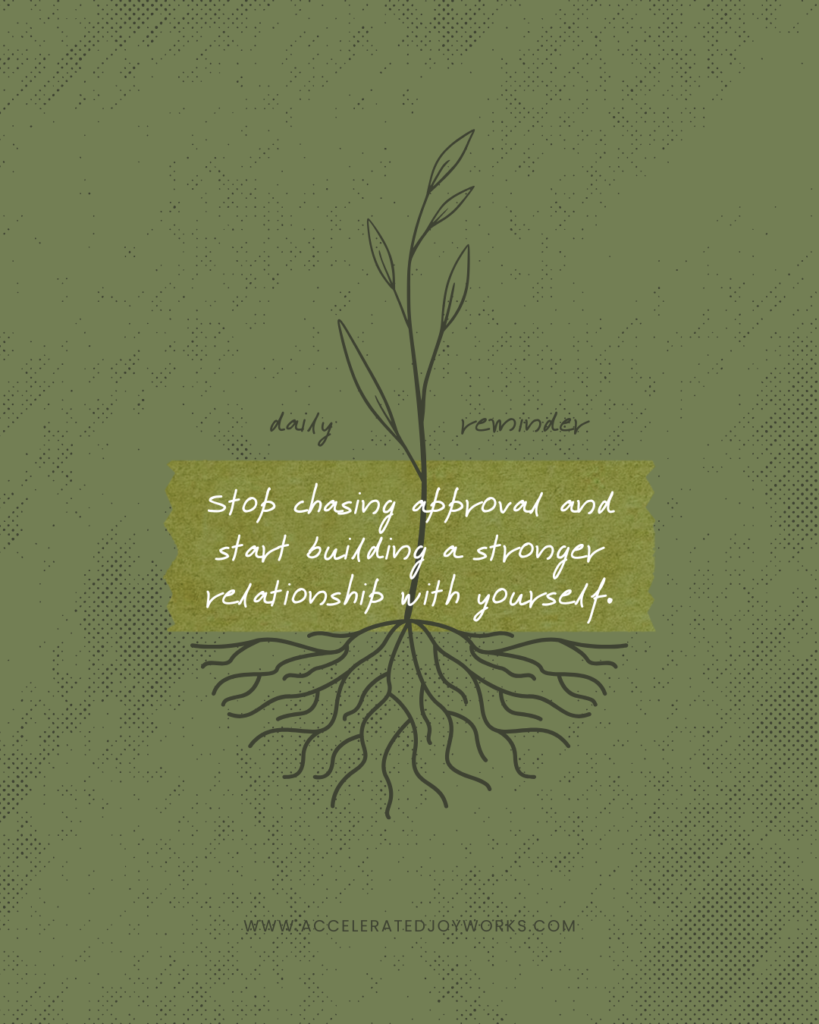
Most importantly, you stop chasing approval and start building a stronger relationship with yourself.
And that relationship influences every other relationship in your life.
Because no amount of external validation can replace the security that comes from knowing your worth isn’t up for negotiation.
Ready to Strengthen Your Relationship With Yourself?
At Accelerated JoyWorks, I help people move beyond people-pleasing, self-doubt, and validation-seeking so they can build healthier relationships with themselves and others.
If you’re ready to trust yourself more deeply and create lasting change, schedule a coaching session today.