Have you ever ended one relationship, entered another, and eventually found yourself thinking:
“How did I end up here again?”
Maybe the people were completely different.
Different personality.
Different history.
Different circumstances.
And yet somehow, you became familiar to yourself again.
You started over-functioning.
You stopped saying what you needed.
You began monitoring their moods.
You questioned yourself.
You tried harder.
You became the understanding one.
The accommodating one.
The one who could handle it.
Until one day you looked around and thought:
“Where did I go?”
It’s tempting to make this entirely about the person you’re with.
Sometimes, of course, the other person’s behavior is the problem. People can be controlling, dismissive, manipulative, unavailable, or simply incompatible with us. Sometimes we continually choose the same kind of people but that’s an article for another day.
This isn’t about blaming yourself for someone else’s choices.
But there is another question worth asking:
What happens to you when you’re in relationship?
Because sometimes the pattern isn’t that you keep choosing the exact same person.
Sometimes it’s that you keep becoming the same version of yourself.
The relationship may change. Your pattern may not.
Imagine two relationships. In the first, your partner is emotionally distant. You work harder to create closeness. You become more accommodating. You try to anticipate what they need. You suppress your frustration because you don’t want to push them away.
Eventually, you feel invisible. Then the relationship ends.
Later, you meet someone who is much more emotionally available.
You think:
“Finally. This is different.”
But when conflict appears, you do what you know. You stop saying what you need. You take responsibility for the emotional temperature of the relationship. You work harder. You become smaller.
And eventually, you’re having the same internal experience.
Not necessarily because you chose the same person.
Because you brought the same relationship with yourself into a different relationship.
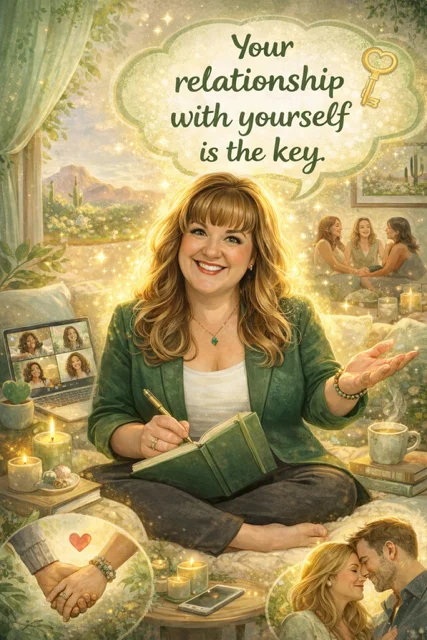
This isn’t about blaming yourself
This distinction matters.
If someone treats you badly, their behavior is their responsibility. You did not cause someone else’s cruelty by having poor boundaries. You did not create another person’s dishonesty. You did not “attract” someone’s abusive behavior because you weren’t healed enough. There is no value in turning relationship coaching into a disguised exercise in blaming the person who was hurt.
But you do have influence over what you do next.
You can learn to recognize your patterns.
You can learn to hear your own voice earlier.
You can learn to tolerate someone else’s disappointment without immediately fixing it.
You can learn to distinguish love from over-functioning.
You can learn to notice when you’re leaving yourself behind.
That’s where your power is.
Ask: “Who do I become in relationship?”
Instead of only asking:
“Why do I keep choosing the wrong people?”
try asking:
“Who do I become when I care deeply about someone?”
Do you become more yourself?
Or less?
Do you speak more honestly?
Or carefully edit yourself?
Do you ask for what you need?
Or wait until someone notices?
Do you tolerate differences?
Or immediately assume you’ve done something wrong?
Do you maintain your friendships, interests, values, and routines?
Or does your world slowly begin revolving around the relationship?
Do you trust your own judgment?
Or constantly look to your partner to determine whether you’re okay?
These questions aren’t about finding fault.
They’re about finding you.
Sometimes the pattern begins with a beautiful quality
This is important because many relationship patterns begin with qualities that aren’t bad.
You may be deeply empathetic.
You may be loyal.
You may be generous.
You may be independent.
You may be incredibly capable.
You may be someone who naturally takes care of things.
You may be excellent at seeing another person’s perspective.
Those qualities can make you a wonderful partner.
But any strength can become a problem when it consistently operates without you.
Empathy without self-connection can become self-erasure.
Generosity without limits can become resentment.
Independence without vulnerability can become isolation.
Understanding everyone else without understanding yourself can become abandonment.
The goal isn’t to get rid of the quality.
It’s to bring yourself back into it.
The pattern often becomes visible in the aftermath
Sometimes we don’t recognize what happened while we’re in it. We recognize it afterward. You realize you haven’t done something you love in months. You realize you’ve stopped talking to certain friends. You realize you don’t remember the last time you made a decision without considering how someone else would react. You realize you’ve been unhappy for a long time but kept telling yourself everything was fine. You realize you don’t know what you want anymore.
And perhaps the most unsettling realization:
You don’t recognize yourself.
That moment can feel devastating.
But it can also be the beginning of returning.
You don’t have to become someone new
When people realize they’ve lost themselves, they often think they need to reinvent themselves.
New hobbies.
New routines.
New wardrobe.
New boundaries.
New relationship.
Sometimes those things are helpful.
But coming back to yourself isn’t necessarily about creating a new version of you.
It can be about remembering what was already there.
What do you enjoy?
What matters to you?
What do you believe?
What do you need?
What makes you feel alive?
What have you been tolerating?
What have you been pretending doesn’t bother you?
What parts of yourself have you been asking permission to have?
Those questions begin to rebuild the relationship that may have been neglected while you were busy maintaining everyone else’s.
The relationship isn’t the only place the pattern lives
And this is why the relationship with yourself matters so much. Your romantic relationship may simply be where the pattern becomes loud enough to hear. The same pattern may show up with family, friends, work, parenting, leadership.
Even in the way you talk to yourself.
If your default response is to override yourself whenever someone else has a need, changing partners won’t necessarily change the pattern.
You have to change your relationship with you.
That’s the deeper work.
You can learn a different way
Imagine being able to stay deeply connected to someone without disappearing into the relationship.
To love someone without making their happiness your responsibility.
To compromise without erasing your needs.
To hear criticism without immediately deciding you’re wrong.
To set a boundary without needing the other person to agree with it.
To be disappointed without abandoning yourself.
To be yourself and let the relationship respond to the real you.
That’s not selfishness.
That’s relational maturity.
And it starts with something deceptively simple:
Coming back to yourself.
Have You Lost Yourself?
If you’re beginning to wonder whether you’ve become disconnected from yourself, my free Have You Lost Yourself? guide can help you recognize the patterns that may be getting in the way of your relationship with yourself.
And if you’re ready to explore your patterns more deeply—with someone who can help you see what’s happening without telling you what you “should” do—you can schedule a Discovery Session.